ESPCI web site
M. Etchevest, P. Dmitruk, S. Karmakar, B. Semin, R. Godoy-Diana, J. E. Wesfreid
Physical Review Fluids, 11, 044603 (2026).
DOI: 10.1103/xcbx-h1kc
[PDF file]
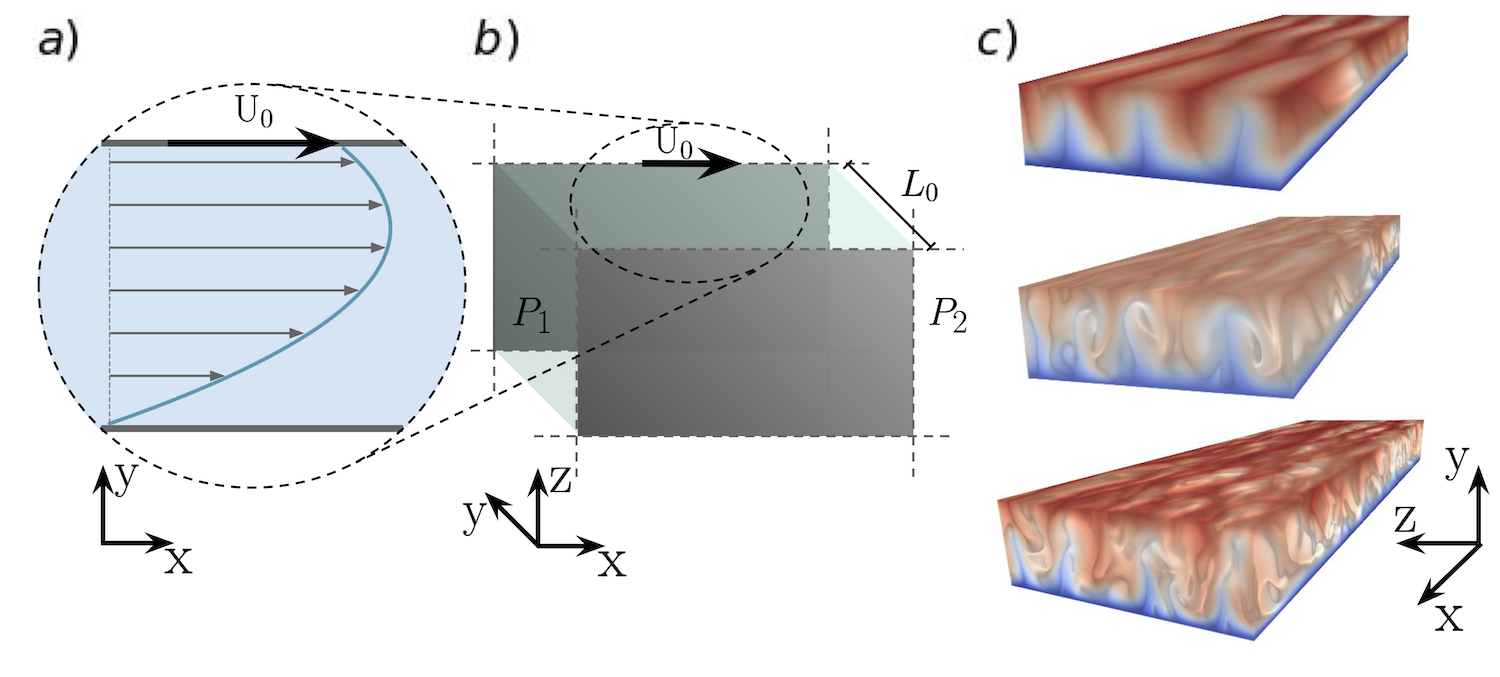
Our previous experimental work on Couette-Poiseuille flow (Liu et al. Phys. Rev. Fluids 2025) measured how the the waviness of streamwise streaks is correlated with the intensity of the streamwise vorticity (the rolls). Here, in collaboration with colleagues from Universidad de Buenos Aires and IRL IFADyFE, we use direct numerical simulations near the transition to turbulence to investigate that nonlinear relationship between streak waviness and rolls. This relationship is a key step in Waleffe’s model for a self-sustaining process. Simulations were conducted for Reynolds numbers ranging from 500 to 940, and a range of initial perturbation amplitudes was used. In these simulations, the streaks, rolls, and streak waviness initially grow. The optimal time for this growth closely matches the linear transient growth period for small perturbations but is much shorter when the initial perturbations are large and highly nonlinear. For higher Reynolds numbers and large initial perturbations, the velocity field reaches a turbulent steady state, while in the remaining cases, the flow relaminarizes. The main result is that the waviness of the streaks is a quadratic function of the rolls, provided that the roll amplitude is sufficiently large.