Waviness and self-sustained turbulence in plane Couette-Poiseuille flow

M. Etchevest, P. Dmitruk, S. Karmakar, B. Semin, R. Godoy-Diana, J. E. Wesfreid
Physical Review Fluids, 11, 044603 (2026).
DOI: 10.1103/xcbx-h1kc
[PDF file]

Our previous experimental work on Couette-Poiseuille flow (Liu et al. Phys. Rev. Fluids 2025) measured how the the waviness of streamwise streaks is correlated with the intensity of the streamwise vorticity (the rolls). Here, in collaboration with colleagues from Universidad de Buenos Aires and IRL IFADyFE, we use direct numerical simulations near the transition to turbulence to investigate that nonlinear relationship between streak waviness and rolls. This relationship is a key step in Waleffe’s model for a self-sustaining process. Simulations were conducted for Reynolds numbers ranging from 500 to 940, and a range of initial perturbation amplitudes was used. In these simulations, the streaks, rolls, and streak waviness initially grow. The optimal time for this growth closely matches the linear transient growth period for small perturbations but is much shorter when the initial perturbations are large and highly nonlinear. For higher Reynolds numbers and large initial perturbations, the velocity field reaches a turbulent steady state, while in the remaining cases, the flow relaminarizes. The main result is that the waviness of the streaks is a quadratic function of the rolls, provided that the roll amplitude is sufficiently large.
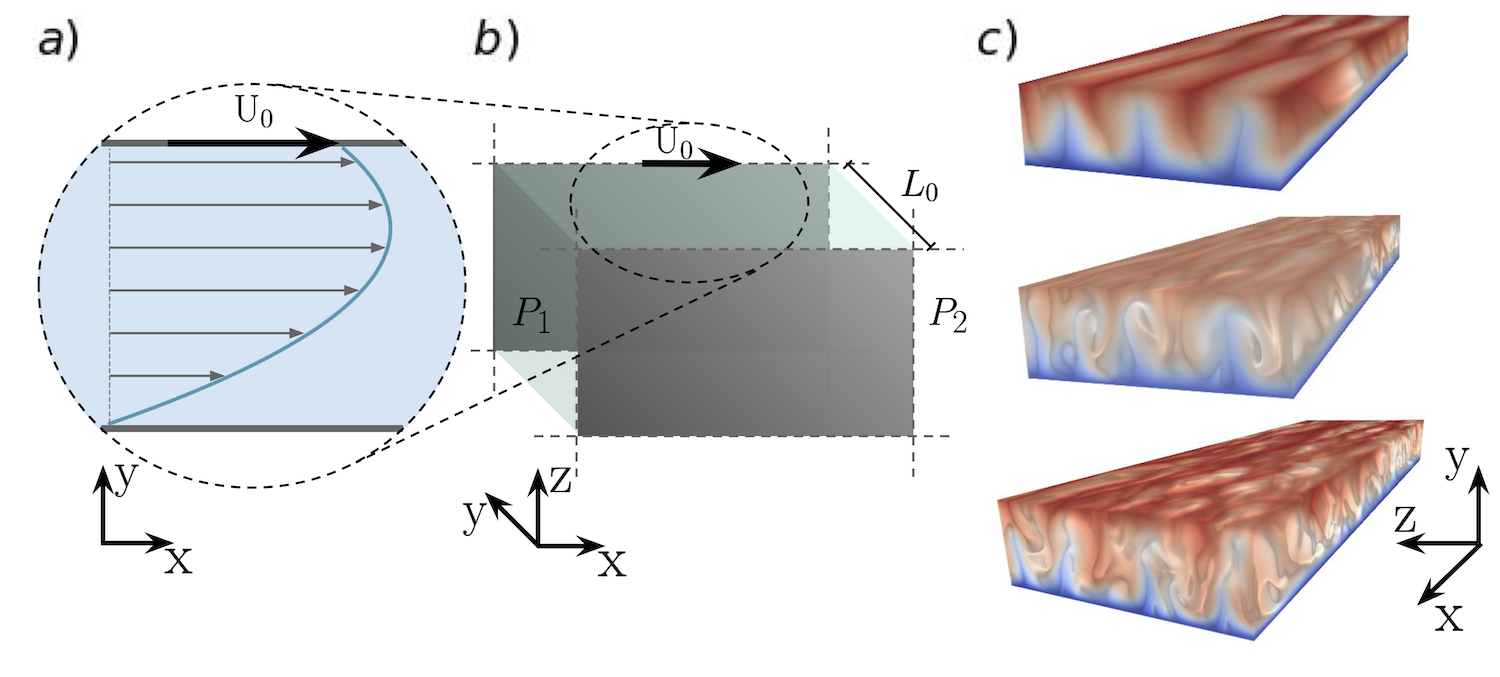
(a) and (b) Schematic representation of a typical Couette-Poiseuille laminar flow considered. (c) Representative three-dimensional (3D) snapshots of the streamwise velocity field Ux (blue is low speed, red is high speed) for three cases, a decaying laminar flow at Re = 625, a transitioning flow at Re = 806, and a fully turbulent case at Re = 940, from top to bottom, respectively. Rendering using the software VAPOR.

Lift-up and streak waviness drive the self-sustained process in wall-bounded transition to turbulence

Flow field measurements from a Couette-Poiseuille experiment are used to examine quantitatively certain steps of the self-sustained process (SSP) of wall-bounded transition to turbulence. Although the different parts of the SSP have been discussed at large in the literature, direct measurements from experiment are scarce and the present results show, using a local analysis of the turbulent patterns, that (1) the amplitude of streamwise rolls is related to streak waviness, bringing a quantitative picture to one of the main physical mechanisms of Waleffe’s model of SSP, and (2), at low waviness, direct measurements of the correlation between the streak and roll amplitudes, respectively probed by the streamwise and wall-normal velocity perturbations, quantify the lift-up effect. This analysis method of the SSP does not rely on the specificity of Couette-Poiseuille flows and can be used to investigate this mechanism in other flows.

T. Liu, B. Semin, R. Godoy-Diana, J. E. Wesfreid
Physical Review Fluids, 9, 033901 (2024).
doi: 10.1103/PhysRevFluids.9.033901

Decay of streaks and rolls in plane Couette–Poiseuille flow

We report the results of an experimental investigation into the decay of turbulence in plane Couette–Poiseuille flow using ‘quench’ experiments where the flow laminarises after a sudden reduction in Reynolds number 𝑅𝑒. Specifically, we study the velocity field in the streamwise–spanwise plane. We show that the spanwise velocity containing rolls decays faster than the streamwise velocity, which displays elongated regions of higher or lower velocity called streaks. At final Reynolds numbers above 425, the decay of streaks displays two stages: first a slow decay when rolls are present and secondly a more rapid decay of streaks alone. The difference in behaviour results from the regeneration of streaks by rolls, called the lift-up effect. We define the turbulent fraction as the portion of the flow containing turbulence and this is estimated by thresholding the spanwise velocity component. It decreases linearly with time in the whole range of final 𝑅𝑒. The corresponding decay slope increases linearly with final 𝑅𝑒. The extrapolated value at which this decay slope vanishes is 𝑅𝑒𝑎𝑧≈656±10, close to 𝑅𝑒𝑔≈670 at which turbulence is self-sustained. The decay of the energy computed from the spanwise velocity component is found to be exponential. The corresponding decay rate increases linearly with 𝑅𝑒, with an extrapolated vanishing value at 𝑅𝑒𝐴𝑧≈688±10. This value is also close to the value at which the turbulence is self-sustained, showing that valuable information on the transition can be obtained over a wide range of 𝑅𝑒.

Decay of streaks and rolls in plane Couette-Poiseuille flow
T. Liu, B. Semin, L. Klotz, R. Godoy-Diana, J. E. Wesfreid & T. Mullin
Journal of Fluid Mechanics 915, A65 (2021)
doi:10.1017/jfm.2021.89