 ESPCI web site
[Funded PhD position – potential start date: Fall 2026]
Labs: PMMH (Paris) + LJK (Grenoble) + LORIA (Nancy)
Context
Architected materials capable of shape transformation under external stimuli are paving the way for revolutionary advances in soft robotics, medicine, and frugal digital technologies. These materials are the focus of an active emerging research field.
Here an ex ample of 3D printed flat material (« shape-memory » polymer) by MFX team : frozen strain during extrusion (and fast cooling) are relaxed when the material is heated, leading to deformation into a programmed shape.
A new actuation and a new approach
We propose a novel approach: designing 3D-printed solid cellular materials whose shape and mechanical properties evolve in a controlled manner under internal depressurization, combined with an equally innovative interdisciplinary approach.
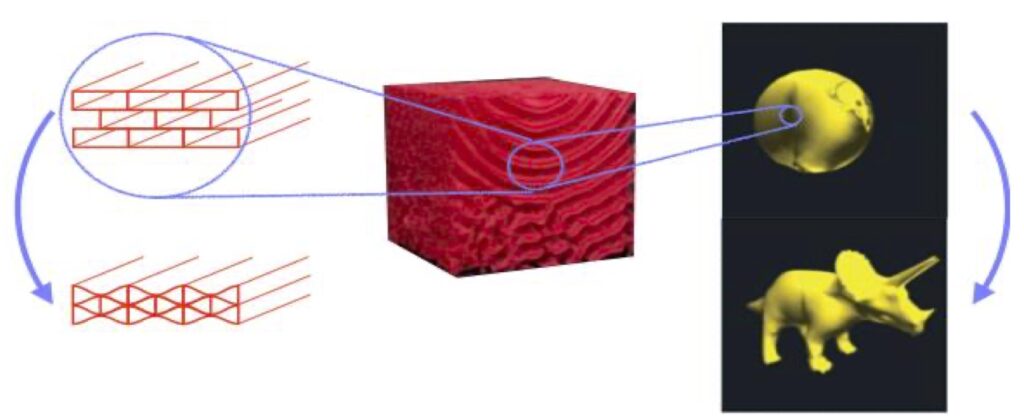
This depression-based actuation is an exciting concept, enabling reversible, large-amplitude deformations while raising new fundamental questions. Another unique aspect of the project is its interdisciplinarity: the collaboration between mechanics/physics (experiments at PMMH) and computer graphics (inverse problems at LJK and printability at LORIA). These disciplines, though recently discovering shared interests, have had limited interaction to date. By leveraging tools and perspectives developed separately, we anticipate significant breakthroughs.
In this CNRS-funded interdisciplinary PhD project, we aim to develop a programmable material-machine capable of deforming into a target geometry when subjected to internal depressurization. The research will focus on:
- Determining the internal architecture of anisotropic cellular patterns (sheets, tubes, staggered patterns, etc.), and optimizing their printability and mechanical characteristics.
- Solving the inverse problem to determine the deformation distributions required to achieve complex shapes.
- Automatically generating printable internal architectures and experimentally testing these new shape-changing materials (using 3D scanning and mechanical testing).
Candidate Profile
- Education: Master’s degree in Physics, Mechanics, or Computer Graphics.
- Passion for experimentation (mechanics, physics, 3D printing) and/or strong interest in programming and numerical methods (optimization, simulation, etc.). In this interdisciplinary work, the balance between disciplines can be adjusted, but the project will inherently rely on the expertise of all three laboratories (with planned research stays at each), opening up a promising new interdisciplinary field.
Contacts
PMMH (ESPCI, Campus Jussieu, Paris 5eme)
José Bico, jose.bico@espci.fr https://blog.espci.fr/jbico
Etienne Reyssat etienne.reyssat@espci.fr
Benoît Roman benoit.roman@espci.fr https://blog.espci.fr/benoitroman
LJK (Genoble) ; team CRAFT
Mélina Skouras, melina.skouras@inria.fr, https://imagine.inrialpes.fr/people/mskouras/index.htm
Georges-Pierre Bonneau, georges-pierre.bonneau@inria.fr, https://team.inria.fr/craft/georges-pierre-bonneau/
LORIA (Nancy) : team MFX
Camille Schreck, camille.schreck@inria.fr schreckc.github.io
Sylvain Lefebvre, sylvain.lefebvre@inria.fr https://antexel.com/sylefeb/research/