 ESPCI web site
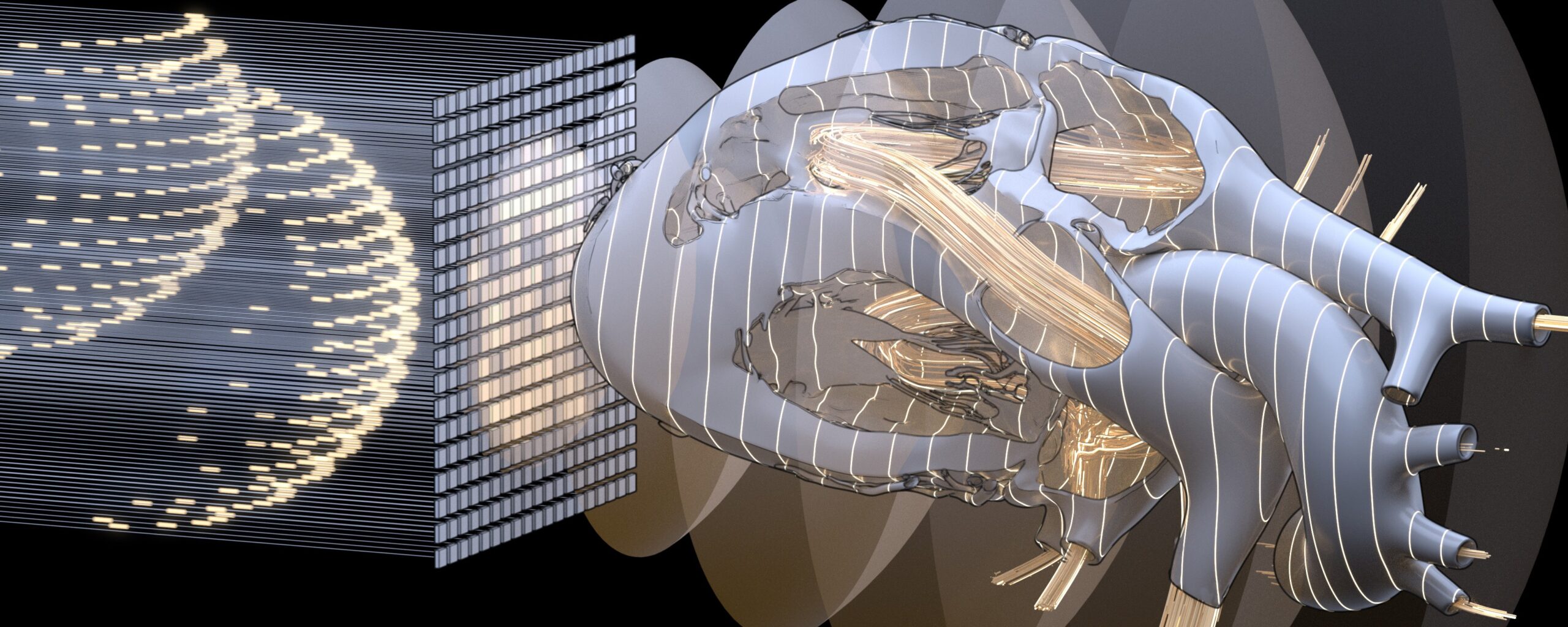
4D Ultrafast Ultrasound: the next revolution in biomedical imaging
Our researcher Clément Papadacci has just published a review with an international group of leading researchers in the field: ultrafast ultrasound imaging was a turning point in medical imaging, revealing rapid physiological phenomena in vivo with unprecedented detail. But anatomy and physiology are inherently three-dimensional, and a 2D plane cannot fully capture shear wave propagation in the heart, complex vascular networks, or brain activation. 4D ultrafast ultrasound overcomes this by extending high-frame-rate imaging into a full volume.
The review covers the foundations of volumetric ultrafast acquisition, key advances in beamforming, motion estimation, Doppler imaging, elastography, and ultrasound localization microscopy (ULM), as well as the hardware challenges of matrix array transducers and emerging solutions such as microbeamforming, sparse arrays, row-column arrays, and wearable probes. It also discusses the growing role of AI and high-performance computing, and the importance of visualization tools for making sense of 4D data.
Applications span in vitro validation to preclinical and early clinical studies in cardiovascular, neurovascular, and abdominal imaging.
Stay tuned to see where 4D ultrafast ultrasound takes us next!
👨🔬👩🔬Co-authors: Jean Provost, Mengxing Tang, Alexandre Dizeux, Pengfei Song, Mickaël Tanter, Béatrice Berthon, Alessandro Ramalli, Piero Tortoli, Pieter Kruizinga, Lasse Løvstakken, Thomas Deffieux, Mathieu Pernot
🖼️Illustration: Alexandre Dizeux


